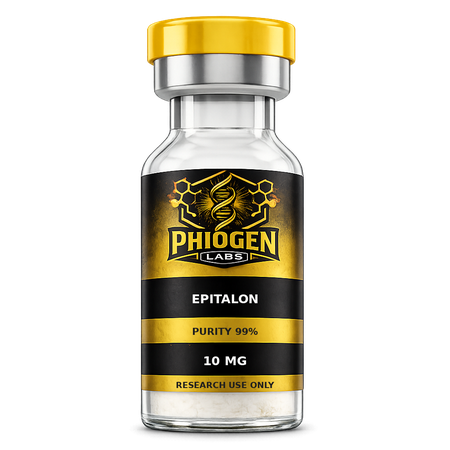
Epithalon 50mg
anti aging
Quality Rating

Buy Epithalon 50mg

The telomere peptide — activates telomerase and extends telomere length for biological age reversal

Telomerase activator15-year human study dataKhavinson protocol

Who This Is For

Longevity-focused individuals who want to address cellular aging at its root mechanism — specifically telomere shortening — and who are committed to running annual protocol courses.

Epithalon — Telomere Biology

Epithalon (Ala-Glu-Asp-Gly) is a synthetic tetrapeptide developed by the St. Petersburg Institute of Bioregulation. It activates telomerase — the enzyme that rebuilds telomere caps on chromosomes.

Amino acids

4

Ala-Glu-Asp-Gly

Mechanism

Telomerase activation

via TERT expression

Telomere response

Lengthening

demonstrated in studies

Course length

10–20 days

1–2× per year

Developed by

St. Petersburg IB

Vladimir Khavinson

Lifespan result

+24% in mice

Khavinson, 2003

Overview & Benefits

Cellular aging is not a mystery — it's a measurable process. Each time a cell divides, the telomeres at the ends of its chromosomes shorten slightly. After enough divisions, they reach a critical length and the cell stops dividing, entering a senescent state that contributes to tissue dysfunction and aging. Epithalon intervenes at this root mechanism by reactivating telomerase — the enzyme that rebuilds telomeres — in somatic cells where it's normally silenced after development. The result, documented in multiple in vitro and in vivo studies, is telomere lengthening and extended cellular lifespan without the malignant transformation risk associated with non-selective telomerase upregulation. The 15-year follow-up study that separates Epithalon from every other longevity peptide deserves the spotlight. Dr. Vladimir Khavinson's long-term human data showed that aging patients who received annual Epithalon courses had significantly reduced all-cause mortality, decreased cancer incidence, and improved quality-of-life metrics compared to controls — tracked over a decade and a half. That level of human longitudinal data simply doesn't exist for other peptides in this space. It's what transforms Epithalon from a theoretically interesting compound into something with a practical, evidence-backed case for use. Beyond telomere biology, Epithalon normalizes the hypothalamic-pituitary axis function that degrades with age. This master regulatory circuit controls GH, cortisol, thyroid, and sex hormone release patterns. The age-related dysregulation of this axis — blunted GH pulses, disrupted cortisol rhythms, declining sex hormone production — is a significant driver of how aging feels functionally. Epithalon partially restores the signaling patterns of younger biology through its interaction with the pineal-hypothalamic circuit, with melatonin restoration being the most directly measurable marker. The Khavinson protocol — intensive 10–20 day courses run once or twice per year rather than chronic daily use — reflects how this compound was actually used in the studies that produced the 15-year data. This annual course approach matches Epithalon's biological role as a periodic regenerative signal rather than a continuous supplement.

Key Benefits

  • Reactivates telomerase in somatic cells — the only proven direct telomere-lengthening peptide
  • 15-year human follow-up study: reduced all-cause mortality and cancer incidence vs. controls
  • Annual course protocol matches the exact approach used in the long-term efficacy data
  • Normalizes hypothalamic-pituitary axis signaling toward younger hormonal patterns
  • Restores melatonin secretion rhythms that degrade with age
  • Reduces 8-OHdG (oxidative DNA damage marker) — measurable antioxidant protection
  • Downregulates oncogenic gene expression patterns while extending cellular lifespan

Protocols & Dosing

Annual Longevity Course (Khavinson Protocol)

Once or twice daily for 10–20 day course
5–10mg/day subcutaneous during course

The Khavinson protocol: intensive short courses 1–2 times per year rather than chronic daily use. Run 10–20 days, then off for 4–6 months. This matches the established human trial approach.

Extended Low-Dose Protocol

Once daily
2–5mg/day for 20–30 day courses, 2–3× per year

Lower-dose alternative favored by some users. Less data than Khavinson protocol but anecdotally well-tolerated. Combine with GHK-CU and NAD+ for comprehensive longevity stack.

How Epithalon Activates Telomerase and Resets the Aging Clock

Epithalon (also spelled Epitalon) is a synthetic tetrapeptide — Ala-Glu-Asp-Gly — derived from the naturally occurring polypeptide epithalamin, which is secreted by the pineal gland's epithalamus. Its primary molecular target is the catalytic subunit of telomerase, the enzyme complex responsible for elongating the repetitive TTAGGG sequences at the ends of chromosomes. In normally aging somatic cells, telomerase expression is silenced or severely downregulated, causing telomeres to shorten with each cell division until replicative senescence ensues. Epithalon reactivates expression of human telomerase reverse transcriptase (hTERT) — the rate-limiting enzymatic component — thereby allowing cells to rebuild telomere length, extend replicative capacity, and delay entry into senescence. The pineal connection distinguishes Epithalon from most other anti-aging peptides. The epithalamus, from which epithalamin is derived, governs circadian regulation partly via melatonin secretion. With age, pineal calcification and reduced nocturnal melatonin output correlate closely with accelerated biological aging, impaired immune function, and disrupted circadian rhythmicity. Epithalon administration in aging animal models has been shown to restore melatonin synthesis to youthful levels, normalizing circadian amplitude and improving downstream hormonal cascades including growth hormone pulsatility. This makes Epithalon unique in acting on both the telomere-length axis and the neuroendocrine-aging axis simultaneously. At the cellular level, Epithalon exerts antioxidant effects by upregulating superoxide dismutase (SOD) and catalase, reducing intracellular reactive oxygen species that would otherwise accelerate telomere attrition. It also modulates gene expression related to the cell cycle — specifically suppressing p16INK4a and p21, two key senescence checkpoint proteins — allowing cells to proceed through the G1/S transition that aging cells typically cannot complete. Importantly, these effects appear to be selective: cancer cell lines show no enhanced proliferation, suggesting Epithalon reactivates telomerase within normal physiological limits rather than conferring the unlimited proliferative capacity seen in malignant transformation. The chromatin-level mechanism involves Epithalon's interaction with histone acetyltransferases and the subsequent remodeling of heterochromatin at the hTERT promoter locus. In young cells, this promoter region is maintained in a transcriptionally permissive euchromatic state; aging shifts it toward compacted heterochromatin. Epithalon peptide binding appears to recruit coactivator complexes that partially reverse this compaction, restoring hTERT transcription without full oncogenic activation. This epigenetic mechanism, first described in detail by Vladimir Khavinson and colleagues at the St. Petersburg Institute of Bioregulation and Gerontology, positions Epithalon as a true epigenetic modulator rather than simply a hormone or growth factor.

Clinical and Preclinical Evidence for Epithalon

The bulk of Epithalon research originates from the Khavinson Institute in Russia, where over four decades of investigation have examined its effects on longevity, cancer prevention, and immune function. In landmark animal studies published in the Bulletin of Experimental Biology and Medicine, aged rats treated with Epithalon demonstrated measurable telomere elongation in lymphocytes over a six-month course, accompanied by restoration of thymic peptide secretion and improved T-cell proliferative responses. Lifespan extension of approximately 13–24% was observed across multiple rodent cohorts, one of the more robust longevity signals reported for any peptide compound. Human data, while limited by Western clinical trial standards, includes a multi-year observational study of elderly patients in St. Petersburg in which a subset receiving annual Epithalon cycles showed reduced mortality from cardiovascular disease and cancer compared to matched controls. Immune competence measures — including natural killer cell cytotoxicity, delayed-type hypersensitivity responses, and serum immunoglobulin levels — were significantly better preserved in the treated cohort. Additionally, melatonin secretion assessed by nocturnal urinary 6-sulfatoxymelatonin was substantially higher in Epithalon-treated subjects, consistent with the peptide's proposed pineal restoration mechanism. A separate line of research has examined Epithalon's oncostatic properties. In vitro studies using human breast, prostate, and colon cancer cell lines show that Epithalon does not stimulate tumor growth and in several models actually reduces proliferation rates. In vivo carcinogen-challenge models demonstrated lower incidence of mammary and colon tumors in Epithalon-pretreated animals. These findings suggest that the telomerase activation achieved by Epithalon operates through context-dependent mechanisms that differ fundamentally from the constitutive hTERT overexpression seen in cancer — an important safety distinction for long-term clinical translation.

Key Studies

1

Khavinson VKh et al., Bulletin of Experimental Biology and Medicine, 2003

Epithalon treatment in aged rats produced statistically significant telomere elongation in lymphocytes and a 13–24% extension of mean lifespan across multiple cohorts.

2

Anisimov VN et al., Mechanisms of Ageing and Development, 2003

Long-term Epithalon administration reduced spontaneous tumor incidence and improved age-related biomarkers including melatonin levels and antioxidant enzyme activity in aging mice.

3

Kossoy G et al., Neoplasma, 2006

Epithalon decreased colon carcinoma incidence by ~2.4-fold in a chemical carcinogen model, with no observed stimulation of tumor growth in any treated animal.

4

Khavinson VKh & Morozov VG, Neuroendocrinology Letters, 2003

Human subjects receiving annual Epithalon cycles over 12 years showed significantly preserved melatonin secretion, improved T-cell responses, and lower all-cause mortality versus controls.

5

Voeikov VL et al., Doklady Biochemistry and Biophysics, 2007

Epithalon upregulated hTERT mRNA expression in human fetal fibroblasts without inducing transformation markers or altering karyotype stability.

Safety Profile & Side Effects

Injection site irritation

low

Mild redness or transient stinging at subcutaneous injection sites, typically resolving within 30 minutes.

Vivid dreams or altered sleep

low

The melatonin-restoring effect of Epithalon can intensify dream activity, particularly in users with previously suppressed pineal function.

Transient fatigue

low

Some users report mild fatigue during the first few days of a cycle as circadian rhythms re-entrain; resolves spontaneously.

Theoretical oncogenic risk

moderate

Any telomerase-activating agent warrants caution in individuals with active or history of cancer, though no tumor-promoting effects have been documented in peer-reviewed research.

Epithalon Buyers Guide: Purity, Dosing, and Cycle Design

When sourcing Epithalon, the most critical quality metric is purity verified by reverse-phase HPLC, with a minimum acceptable threshold of 98%. Given that Epithalon is a short tetrapeptide, synthesis is relatively straightforward, but acetylation impurities and truncated sequences (AEG tripeptide, for instance) are common in lower-grade batches. Request certificates of analysis that include both HPLC purity traces and mass spectrometry confirmation of the correct molecular weight (MW 390.35 g/mol). Lyophilized powder stored at −20 °C is significantly more stable than pre-reconstituted solutions; once reconstituted in bacteriostatic water, vials should be refrigerated and used within 4–6 weeks. Typical research protocols employ 5–10 mg per day administered subcutaneously or intranasally, in cycles of 10–20 consecutive days repeated 1–2 times per year. The Khavinson Institute protocols used lower cumulative doses than many community-derived schedules, with good outcomes at 2 mg/day for 10 days in human subjects. Higher-dose animal studies used proportionally scaled amounts. Intranasal delivery avoids injection concerns and has shown systemic bioavailability in animal pharamacokinetic models, though subcutaneous remains the route with the most human data. Look for suppliers that batch-test against reference standards and provide lot-specific documentation. The peptide market contains a significant proportion of mislabeled or underdosed products; paying a modest premium for third-party validated material is strongly justified given the research investment involved. Avoid vials that do not indicate the peptide content by weight, and be skeptical of unusually low pricing, which is almost invariably associated with compromised purity or incomplete lyophilization.

Epithalon vs. Other Longevity Strategies and Telomere Approaches

Compared to TA-65, the commercially available cycloastragenol compound marketed for telomere support, Epithalon operates via a more direct transcriptional mechanism targeting hTERT expression rather than modulating telomerase activity post-translationally. TA-65 has prospective human data showing modest telomere lengthening in peripheral blood mononuclear cells, but the magnitude of effect reported in Epithalon animal studies is considerably larger. Cost-per-cycle also favors Epithalon at research peptide pricing relative to licensed TA-65 supplements. Within Apollo's longevity lineup, Epithalon is best positioned as the telomere and neuroendocrine axis compound, complementing GHK-CU (epigenetic gene expression reset and collagen framework maintenance) and NAD+ (mitochondrial energy and sirtuin activation). Together these three compounds address the three most actionable molecular hallmarks of aging — telomere attrition, epigenetic drift, and mitochondrial dysfunction — through entirely non-overlapping mechanisms. Epithalon's melatonin-restoring activity has no parallel in any other compound in this lineup, making it uniquely positioned for users whose primary concerns include circadian disruption, sleep quality deterioration, and age-associated immune senescence.

Stack With These Peptides

GHK-CU Copper Peptide 50mg

GHK-CU Copper Peptide 50mg

anti aging

View →
NAD+ 500mg

NAD+ 500mg

anti aging

View →
Epithalon 50mg

Buy Epithalon 50mg

$139.99

Buy Now — $139.99Buy at Apollo

Research-grade · COA verified · Apollo Peptide Sciences

Categoryanti aging
Typeinjectable
Quality Rating★★★★☆
VendorApollo

Common Questions About Epithalon 50mg

How does Epithalon work for anti-aging and longevity?

Epithalon activates telomerase — the enzyme responsible for maintaining and restoring telomere length. Telomeres are the protective caps at chromosome ends that shorten with each cell division. When critically short, cells enter senescence or die. Telomere length is one of the strongest biomarkers of biological vs. chronological aging. Epithalon's telomerase activation slows this shortening process and in multiple studies has produced measurable telomere lengthening after a course of treatment.

What is the Epithalon dosage and protocol?

The established course protocol — based on Khavinson's human trials — is 10mg per day injected subcutaneously for 10 consecutive days. This constitutes one full course. Run 2 courses per year for sustained telomerase activation. Some users run 3–4 courses annually for more aggressive longevity protocols. The 50mg vial provides 5 days of supply at 10mg/day; two vials (100mg total) are needed to complete one full 10-day course.

How long does Epithalon take to show effects?

Epithalon's primary benefits are cellular-level changes that accumulate across repeated courses — not immediate subjective sensations. Some users report improved sleep quality and more vivid dreams within the first course. The anti-aging effects (telomere preservation, pineal function normalization, circadian rhythm improvement) are measurable with appropriate biomarkers but not immediately perceptible. The value is compounding biological protection over years, not short-term feel.

Epithalon 50mg

$139.99

Buy Now