9 compounds · from $44.99
Vitalmaxxing — Epitalon, MOTS-c, NAD+ & Senolytics
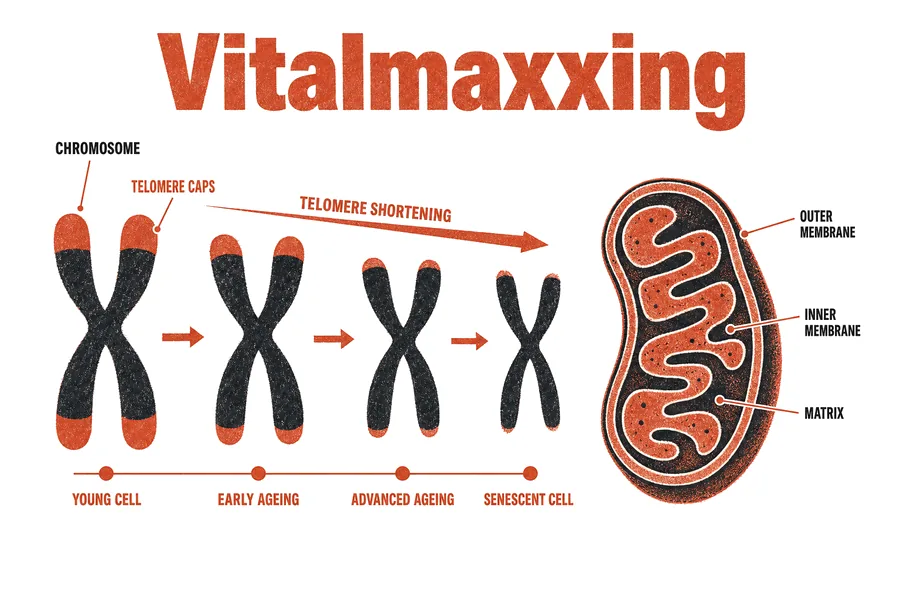
Vitalmaxxing is organised around the hallmarks-of-aging framework rather than around a single mechanism, which means the compounds here have less in common with each other than on any other shelf. Mitochondrial function, telomere maintenance, NAD+ depletion and senescent-cell accumulation are four separate problems, and a compound that addresses one says nothing about the others. Evidence quality varies just as widely — Epitalon has decades of longitudinal data behind it while FOX04-DRI is recent preclinical work with no human record at all. Read each compound page for where its specific evidence sits rather than treating the shelf as a single tier. Everything ships lot-matched with its certificate.
Epitalon
50 MG
NAD+
500 MG
FOXO4-DRI
10 MG
Gonadorelin Acetate
MOTS-c
10 MG
NA-Epitalon
10 MG
P21
10 MG
SS-31
10 MG
Thymulin
10 MG
The Mitochondrial Group
Three compounds here target the same organelle at different failure points. MOTS-c is encoded in mitochondrial rather than nuclear DNA, activates AMPK, and shifts substrate preference toward fatty acid oxidation. NAD+ is supplied directly as the coenzyme in 500 mg and 1000 mg vials, which sidesteps the conversion steps oral NMN and NR precursors depend on and the losses that come with them. SS-31 concentrates at the inner mitochondrial membrane and binds cardiolipin, stabilising cristae structure and reducing electron leak. Running all three is common precisely because they do not overlap.
Epitalon and the Telomerase Claim
Epitalon is Ala-Glu-Asp-Gly, four residues, and it is the most-studied compound on this shelf by a wide margin. The two claims attached to it are pineal-melatonin restoration and telomerase upregulation, with the latter supported by cell-culture work showing telomere elongation in somatic cells that had already reached replicative limits. The longitudinal human data is where it becomes both more interesting and more contested — multi-year Russian cohort studies reported mortality differences, but the methodology would not satisfy a modern trial registry. NA-Epitalon is an N-acetylated variant offered for improved stability.
Senolytics Are the Newest Thing Here
FOX04-DRI is a designed peptide that disrupts the FOXO4-p53 interaction senescent cells rely on to avoid apoptosis, effectively removing their survival mechanism while leaving healthy cells alone. The preclinical results in aged mice were striking enough to drive most of the current interest in the category. It is also the compound on this shelf with the least evidence behind it by a considerable margin — no human data, and an intermittent dosing model that looks nothing like the rest of the catalogue. It belongs here as research material and the evidence gap should be read as the headline, not a footnote.
Reading Evidence Grades on This Shelf
The spread on this shelf runs from decades of longitudinal human observation down to single preclinical mouse studies, and the compounds sit next to each other at similar prices, which flattens a distinction that matters enormously. NAD+ and MOTS-c have mechanistic clarity and reasonable supporting work. Epitalon has volume of evidence concentrated in one research tradition. SS-31 has been through human trials for specific indications. FOX04-DRI and P21 have neither volume nor human data. Price is not a proxy for evidence anywhere in this catalogue, and least of all here.