16 compounds · from $62.99
Khavmaxxing — 17 Khavinson Organ-Targeted Bioregulators
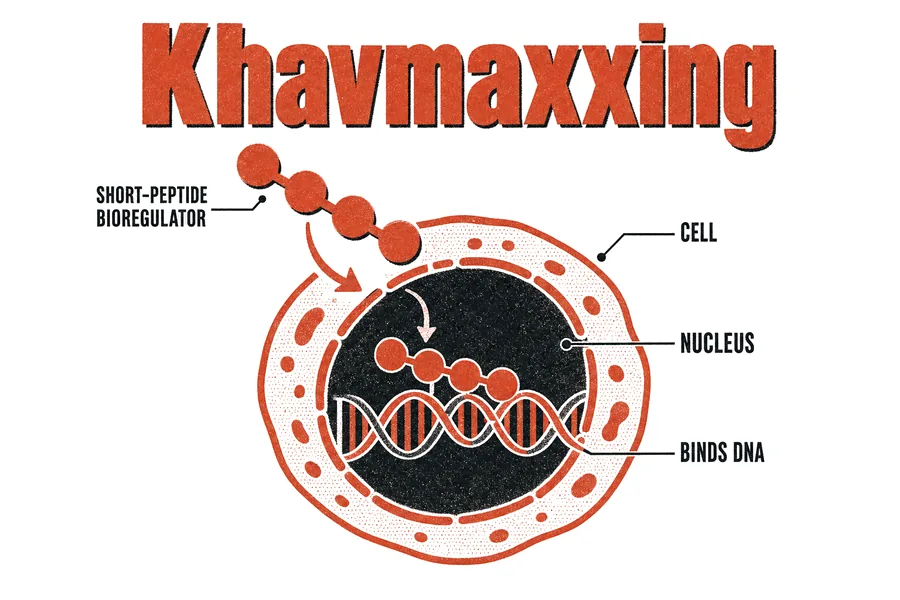
Khavmaxxing is the full Khavinson bioregulator series, seventeen vials of two-to-four-residue peptides out of the Saint Petersburg Institute of Bioregulation and Gerontology. These compounds do not behave like anything else in this catalogue, and reading them through a conventional pharmacological lens produces confusion rather than insight. There is no receptor agonism, no dose-response curve of the kind the incretins produce, and the protocols are short cyclical courses rather than sustained administration. What is proposed instead is a regulatory effect at the level of transcription in one specific tissue. The literature is real and substantial and also concentrated almost entirely in one language and one research tradition, which is the honest caveat to carry into it.
Adamax
10 MG
Bronchogen
20 MG
Cardiogen
20 MG
Chonluten
20 MG

Cortagen
20 MG
Crystagen
20 MG
Livagen
20 MG
Ovagen
20 MG
Pancragen
20 MG
Pinealon
10 MG
Prostamax
20 MG

Testagen
20 MG
Thymogen
20 MG
Vesilute
20 MG
Vesugen
20 MG
Vilon
20 MG
The Organ-Specificity Premise
Each bioregulator is modelled on the regulatory peptide pool of one particular organ and is theorised to restore that organ's protein-synthesis programme. The proposed mechanism is direct interaction with promoter regions of tissue-specific genes — the peptides are short enough to enter the nucleus and specific enough to bind particular sequences. Pinealon and Cortagen target brain tissue, Cardiogen and Vesugen cardiovascular, Livagen hepatic, Ovagen ovarian, Pancragen pancreatic, Bronchogen and Chonluten bronchial, Thymogen and Vilon and Crystagen thymic, Testagen testicular, Prostamax prostatic, Vesilute urinary. Selection follows the tissue in question rather than any general ranking.
Why the Protocols Look Different
Bioregulator courses are typically ten to twenty days, repeated a few times a year, at doses that look trivially small next to anything else in the catalogue. That is not conservatism — it follows from the proposed mechanism. A compound acting on transcription does not need continuous presence the way a receptor agonist does; the effect, if it exists, outlasts the administration. Applying stacking or escalation logic from the Burnmaxxing or Sizemaxxing shelves here produces protocols that make no sense against the underlying theory.
The State of the Evidence
Five decades of published work sits behind this series and the volume is genuinely large. The difficulty for anyone evaluating it from outside is that it is concentrated in Russian-language journals from a period and publishing culture with different methodological expectations than a modern registered trial, and independent Western replication is sparse. Khavinson has authored English-language reviews summarising the programme and those are the practical entry point. Anyone treating this shelf as settled is reading it wrong; anyone dismissing it without reading the primary material is doing the same thing from the other direction.
Where Most People Start
Pinealon and Cortagen are the two most frequently ordered from the lineup, largely because the brain-tissue claims have the most accessible English-language write-ups behind them rather than because they have the strongest evidence. Thymogen and Vilon come next, tied to the thymic-involution literature that motivated much of the original programme. Beyond those four, ordering patterns follow whichever tissue a given research question concerns, which is how the series was designed to be used in the first place.