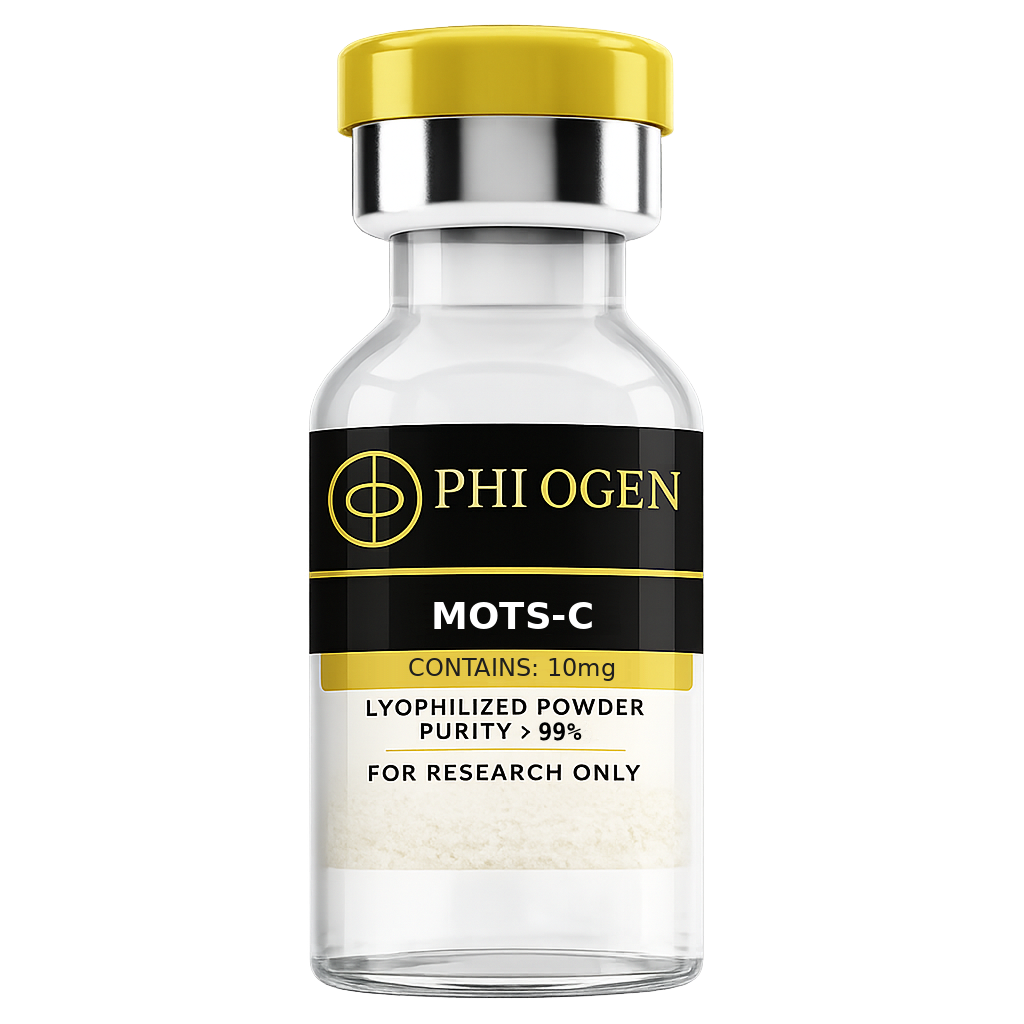
MOTS-c 10mg
healing
Quality Rating

Buy MOTS-c 10mg

Mitochondrial peptide — metabolic flexibility, insulin sensitivity, and exercise adaptation

Mitochondrially encoded peptideInsulin sensitivity improvementLifespan extension in animals

Who This Is For

Users seeking mitochondrial-level metabolic optimization, insulin sensitivity improvement, and longevity-focused protocols.

Overview & Benefits

MOTS-c (mitochondrial open reading frame of the 12S rRNA-c) is a peptide encoded in mitochondrial DNA that acts as a systemic metabolic regulator. It activates AMPK, regulates the folate cycle and de novo purine synthesis, and translocates to the nucleus under metabolic stress to regulate gene expression. In animal models it prevented obesity and type 2 diabetes on high-fat diets, improved insulin sensitivity dramatically, and extended lifespan. Exercise causes natural MOTS-c elevation — it may mediate many of exercise's metabolic benefits.

Key Benefits

  • Mitochondrially encoded — directly linked to metabolic health and longevity
  • Prevents obesity and improves insulin sensitivity in animal models
  • AMPK activation for metabolic flexibility and fat oxidation
  • Exercise-mimetic properties — elevates naturally with physical activity
  • Lifespan extension in animal models

Protocols & Dosing

Metabolic Protocol

Once daily or 3–5x weekly
5–10mg subcutaneous

Best dosed before exercise to amplify natural MOTS-c elevation. Run 4–8 week cycles.

MOTS-c: The Mitochondrial Hormone That Rewires Metabolic Signaling

MOTS-c (Mitochondrial Open Reading Frame of the 12S rRNA type-c) is a 16-amino acid mitochondria-derived peptide (MDP) encoded by a small open reading frame within the mitochondrial 12S ribosomal RNA gene — a discovery that fundamentally expanded understanding of mitochondrial biology beyond energy production to include endocrine signaling. Unlike nuclear-encoded peptides, MOTS-c is transcribed from mitochondrial DNA and translated using mitochondrial ribosomes, then exported to the cytoplasm and nucleus where it exerts transcriptional regulatory effects. Its circulating levels in blood decline significantly with age and in states of metabolic dysfunction such as obesity and type 2 diabetes, establishing it as a measurable biomarker of mitochondrial health. The primary signaling mechanism of MOTS-c involves activation of AMP-activated protein kinase (AMPK), the master cellular energy sensor that responds to elevated AMP/ATP ratios to activate catabolic pathways and suppress anabolic ones. MOTS-c activates AMPK through the AICAR (5-aminoimidazole-4-carboxamide ribonucleotide) pathway: it inhibits the folate cycle enzyme AICAR transformylase, causing intracellular AICAR accumulation, which directly activates AMPK. AMPK activation in turn triggers mitochondrial biogenesis via PGC-1α, enhances fatty acid oxidation, improves glucose uptake via GLUT4 translocation independent of insulin, and suppresses hepatic glucose production. This makes MOTS-c a potent insulin-sensitizing agent whose mechanism of action is entirely distinct from insulin itself. In addition to its metabolic effects, MOTS-c enters the nucleus in response to metabolic and oxidative stress, where it binds to ARE (antioxidant response element) sequences and activates the NRF2-KEAP1 antioxidant pathway. This transcriptional program upregulates a suite of detoxifying enzymes including heme oxygenase-1 (HO-1), glutathione S-transferase, and thioredoxin reductase, providing robust protection against reactive oxygen species generated during exercise or metabolic challenge. The dual cytoplasmic/nuclear activity of MOTS-c — metabolic reprogramming in the cytoplasm, antioxidant gene induction in the nucleus — makes it unusual among peptide hormones in having both rapid non-genomic and slower genomic components to its action. MOTS-c levels are physiologically regulated by exercise and caloric restriction — two of the most well-validated interventions for extending healthspan. Intense aerobic exercise dramatically increases circulating MOTS-c within minutes, peaking 30–60 minutes post-exercise. This exercise-induced MOTS-c release may mediate a significant portion of the systemic metabolic benefits of physical activity, including improved insulin sensitivity, enhanced skeletal muscle oxidative capacity, and anti-inflammatory effects. The peptide thus functions as an "exercise mimetic" in the sense that exogenous administration can recapitulate key molecular downstream effects of exercise in states where physical capacity is limited by age or disease.

MOTS-c Research: Metabolic, Aging, and Exercise Biology

MOTS-c was discovered in 2015 by Pinchas Cohen's group at USC, who reported in Cell Metabolism that the peptide regulated insulin sensitivity and prevented diet-induced and age-dependent insulin resistance in mice. Subcutaneous administration of MOTS-c in high-fat diet mice for 3 weeks prevented weight gain comparable to standard laboratory chow controls, normalized fasting glucose and insulin levels, and improved oral glucose tolerance to young-control levels. Mechanistic studies confirmed AMPK as the primary mediator: MOTS-c effects were abolished in AMPK-knockout mice. These metabolic results were reproduced in aged mice, where MOTS-c injection reversed age-associated insulin resistance and improved skeletal muscle mitochondrial function. Subsequent research expanded MOTS-c's relevance to exercise physiology. Kim et al. (2022, Nature Metabolism) demonstrated that MOTS-c is produced in skeletal muscle in an exercise-intensity-dependent manner and circulates systemically after exercise, where it acts on the liver and adipose tissue to coordinate whole-body metabolic adaptation. Exogenous MOTS-c enhanced endurance capacity in young adult mice by ~15% as measured by time to exhaustion in treadmill running, and by ~35% in aged mice — a differential that suggests greater functional reserve recovery in the aging context. The same study showed MOTS-c enhanced mitochondrial respiration in both slow-twitch and fast-twitch muscle fibers. A 2023 study in Science Advances examined MOTS-c in the context of aging biology, finding that circulating MOTS-c levels in a human cohort of centenarians were significantly higher than in age-matched controls who had not reached extreme longevity. While observational, this finding is consistent with the mechanistic data suggesting MOTS-c is a contributor to metabolic resilience and longevity. The centenarian MOTS-c levels correlated with preserved insulin sensitivity, lower inflammatory cytokines, and better muscle mass index — pointing toward MOTS-c as a potential circulating biomarker for healthy aging.

Key Studies

1

Lee C et al., Cell Metabolism, 2015

MOTS-c prevented diet-induced insulin resistance and reversed age-related insulin resistance in mice via AMPK-dependent metabolic reprogramming, representing the first characterization of this mitochondria-encoded peptide hormone.

2

Kim SJ et al., Nature Metabolism, 2022

Exercise-stimulated MOTS-c production in skeletal muscle was identified as a systemic exercise signal; exogenous MOTS-c improved endurance capacity by 15–35% in mice and enhanced mitochondrial respiration across muscle fiber types.

3

Reynolds JC et al., Nature Aging, 2021

MOTS-c translocated to the nucleus in response to metabolic stress and activated ARE-dependent antioxidant gene programs, providing a genomic mechanism for its cytoprotective effects beyond AMPK activation.

4

Zarse K & Ristow M, Cell Metabolism, 2015

Commentary confirming MOTS-c as the first mitochondrially-encoded peptide with hormone-like systemic functions, noting its evolutionary conservation and implications for mitochondrial-nuclear communication.

5

Bhatt MP et al., Science Advances, 2023

Centenarians exhibited significantly elevated circulating MOTS-c levels compared to age-matched controls, correlating with preserved metabolic health markers and lower inflammatory burden.

Safety Profile & Side Effects

Hypoglycemia

moderate

MOTS-c substantially improves insulin sensitivity and promotes glucose uptake; users with diabetes or on hypoglycemic medications should monitor blood glucose and adjust medication dosing accordingly.

Injection site discomfort

low

Mild redness or transient soreness at subcutaneous injection sites; rotating injection locations prevents local buildup and skin irritation.

Appetite changes

low

AMPK activation can suppress appetite; some users report reduced hunger particularly in the hours following injection, which resolves within a day.

Fatigue (initial)

low

Metabolic reprogramming from glucose to fatty acid oxidation during initial dosing may cause transient energy dips as cells adapt to increased mitochondrial beta-oxidation.

MOTS-c Buyers Guide: Purity, Dosing Protocols, and Storage

MOTS-c is a 16-residue peptide with a straightforward linear structure, making synthesis accessible to quality peptide manufacturers. The primary quality concern is purity: HPLC purity ≥98% with mass spectrometry confirmation of the correct molecular weight (MW 2174.5 g/mol) are the minimum acceptable standards. Endotoxin testing is particularly important for a peptide intended for injection, as bacterial lipopolysaccharide contamination from synthesis media can cause local inflammatory reactions disproportionate to the peptide's actual pharmacological activity. Research protocols derived from animal dose translation and community reporting have used MOTS-c in the range of 5–10 mg per session subcutaneously, administered 2–3 times per week. The original Lee et al. mouse studies used 0.5 mg/kg/day subcutaneously; allometric scaling to a 75 kg human gives approximately 3–5 mg per dose. Cycle lengths of 4–8 weeks with 2–4 week breaks are commonly reported, allowing assessment of metabolic response between cycles. MOTS-c is best used in the context of an active exercise program, as exercise synergizes with and may enhance its AMPK-activating effects. Storage follows standard peptide protocols: lyophilized powder at −20 °C, protected from freeze-thaw cycling. Reconstitute with bacteriostatic water (not saline, which can degrade shorter peptides more rapidly) and store reconstituted vials at 4 °C for up to 4 weeks. Because MOTS-c is derived from a mitochondrial gene, its natural sequence is highly conserved — verify the supplier is using the correct human MOTS-c sequence rather than a murine variant, which differs slightly in amino acid composition and may have different potency in human tissue contexts.

MOTS-c vs. Other Metabolic Peptides and Exercise Mimetics

MOTS-c occupies a unique niche among metabolic peptides because its mechanism begins within the mitochondrion itself — it is literally encoded in the organelle whose dysfunction it remedies. Compared to Humanin (another mitochondria-derived peptide discovered by the same Cohen group), MOTS-c has stronger metabolic effects — particularly on insulin sensitivity and glucose disposal — while Humanin's advantages lie more in neuroprotection and cardioprotection. The two MDPs are often discussed as a complementary pair, targeting overlapping but distinct aspects of mitochondrial-mediated healthspan. Against GLP-1 receptor agonists such as semaglutide, MOTS-c operates through an entirely different mechanism that is weight-loss agnostic — its insulin-sensitizing effects are not primarily driven by appetite suppression or caloric restriction but by direct enhancement of mitochondrial metabolic efficiency. MOTS-c users often report improved body composition without significant weight loss, reflecting a shift in substrate utilization toward fat oxidation rather than a reduction in total energy intake. For individuals with metabolic dysfunction who also wish to preserve or improve physical performance, MOTS-c's exercise-mimetic profile and enhancement of exercise capacity makes it a compelling choice compared to the purely appetite-suppressive GLP-1 agonists.

Stack With These Peptides

AICAR 50mg

AICAR 50mg

fat loss

View →
MOTS-c 10mg

Buy MOTS-c 10mg

$129.99

Buy Now — $129.99Buy at Phiogen

Research-grade · COA verified · Phiogen
Categoryhealing
Typeinjectable
Quality Rating★★★★☆
VendorPhiogen

MOTS-c 10mg

$129.99

Buy Now